

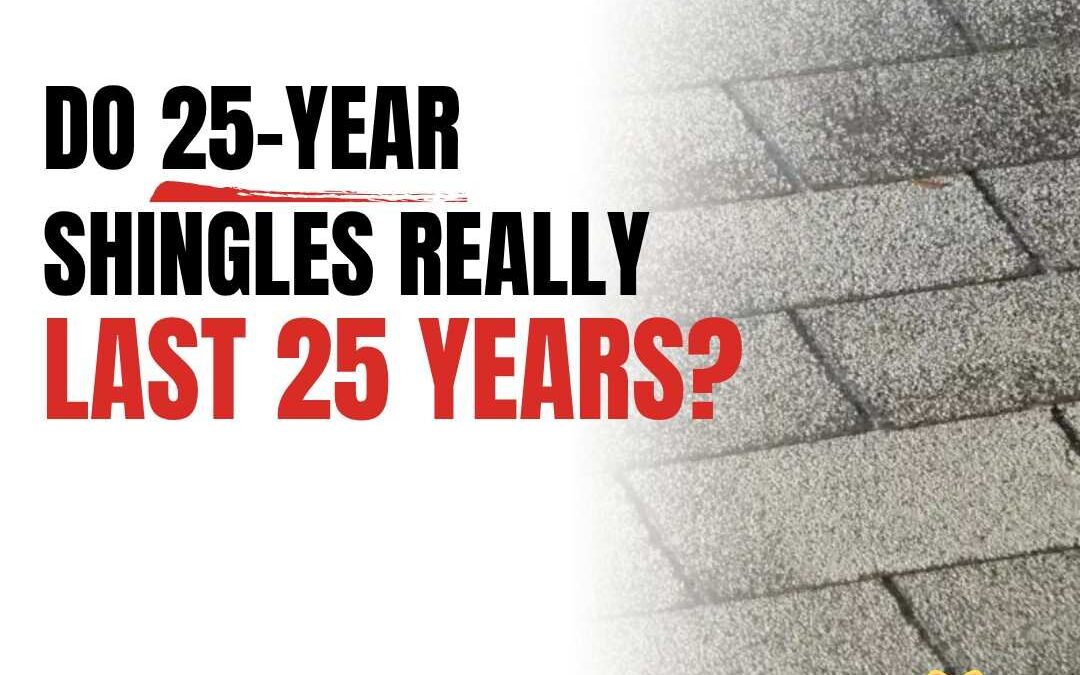
A 25-year shingle typically lasts between 12 and 20 years under real-world conditions. The “25-year” label reflects a manufacturer’s performance rating under controlled assumptions, not a guarantee of how long the shingles will hold up on your actual roof. Climate exposure, installation quality, attic ventilation, and maintenance habits all determine whether your shingles reach that number, fall short of it, or occasionally exceed it. For most homeowners in Dacula, GA, planning around a 15–20 year realistic lifespan is the smarter approach.
What the 25-Year Rating Actually Means
A 25-year shingle rating is a manufacturer’s classification, not a lifespan promise. It tells you the product tier and the conditions under which the shingle is designed to perform, not how long it will last on your specific roof.
The rating assumes proper installation, adequate ventilation, and average weather exposure. When those conditions are met consistently, the shingles can approach or reach the rated lifespan. When they are not, the shingles degrade faster, and the warranty often provides less protection than homeowners expect.
How Manufacturers Define the Warranty Period
Most 25-year shingle warranties are prorated, meaning the coverage value decreases significantly after the first few years. A shingle that fails at year 18 may only qualify for a fraction of its original replacement value. Manufacturers also require proof of proper installation and ventilation compliance to honor any claim. Without documentation from a licensed contractor, many warranty claims are denied outright.
Why Real-World Lifespan Falls Short of the Label
The gap between the rated lifespan and actual performance comes down to cumulative stress. Georgia’s heat cycles, UV intensity, and summer storm activity accelerate granule loss and shingle brittleness faster than the manufacturer’s baseline assumptions account for. A roof in Dacula faces more thermal expansion and contraction cycles per year than roofs in cooler climates, which shortens the effective service life regardless of the product’s rating.
The rating tells you what the shingle was built to handle. How attic ventilation affects shingle life determines whether it actually gets there.
What Determines How Long Your Shingles Actually Last
Four variables control real-world shingle lifespan more than the product rating does: ventilation, installation quality, roof pitch, and maintenance frequency. Of these, ventilation and installation have the largest impact and are the two factors most often overlooked during a roofing project.
A roof that runs 10 to 15 degrees hotter than it should because of poor attic airflow will lose years of service life. Heat trapped beneath the deck accelerates shingle aging from the underside, a form of degradation that is invisible until the damage is already significant.
Installation Quality and Ventilation Impact
Improper nailing patterns, misaligned starter strips, and inadequate underlayment all create points of early failure. Even a high-quality shingle installed incorrectly will underperform its rating. Ventilation failures compound the problem. When intake and exhaust vents are blocked or undersized, heat and moisture build up in the attic, softening the roof deck and degrading the shingle adhesive strips that hold tabs sealed against wind uplift.
Signs Your 25-Year Shingles Are Failing Early
Shingle failure rarely happens all at once. It shows up gradually through specific, identifiable warning signs that most homeowners can spot from the ground or during a gutter cleaning.
Granule loss is the most common early indicator. If your gutters are collecting heavy granule deposits, the shingles are losing the protective coating that shields them from UV damage. Curling edges, either cupping upward or clawing downward, signal moisture imbalance and thermal stress. Cracked or missing shingles after a storm indicate the material has become brittle and is no longer flexible enough to absorb impact. Dark streaking from algae growth is cosmetic on its own but signals moisture retention that accelerates underlying deterioration.
If you are seeing two or more of these signs on a roof that is 12 to 15 years old, the shingles are likely in the final phase of their service life. Understanding what a full roof replacement costs in Dacula at that point helps you plan before the damage forces the decision.
Conclusion
A 25-year shingle is a product rating, not a lifespan guarantee. Most roofs in Dacula, GA will see 15 to 20 years of reliable performance when installed and maintained correctly.
Knowing the warning signs and understanding what shortens shingle life puts you ahead of costly emergency repairs. A professional roof inspection gives you a clear picture of where your roof stands before problems escalate.
At Good Shepherd Roofing, we help Dacula homeowners make confident, informed decisions about their roofs. Contact us to schedule your inspection today.
Frequently Asked Questions
Can a 25-year shingle last longer than 20 years?
Yes. With proper installation, adequate attic ventilation, and routine maintenance, some 25-year shingles reach their full rated lifespan. Consistent upkeep is the primary factor that extends performance beyond the average range.
Does climate affect how long 25-year shingles last?
Significantly. Georgia’s heat, humidity, and UV exposure accelerate granule loss and shingle brittleness. Dacula homeowners should expect the lower end of the lifespan range compared to roofs in cooler, drier climates.
What voids a 25-year shingle warranty?
Improper installation, inadequate ventilation, and failure to use manufacturer-approved underlayment and accessories are the most common causes of warranty voidance. Always use a licensed contractor who documents the installation process.
How do 25-year shingles compare to 30-year shingles?
Thirty-year shingles, typically architectural or dimensional shingles, are thicker, heavier, and more resistant to wind and impact. They carry a longer warranty and generally outperform 25-year three-tab shingles in durability and weather resistance.
When should I replace 25-year shingles in Dacula, GA?
Plan for evaluation between years 12 and 15. If you see granule loss, curling, cracking, or missing shingles, schedule a professional inspection immediately. Waiting until visible leaks appear typically means the roof deck has already sustained damage.